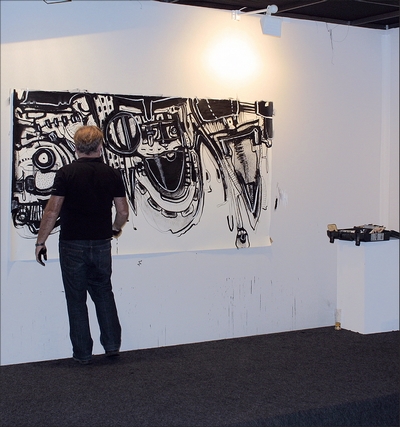
Giving paint some air.
To intellectuals observing contemporary painting with ceremonious
gravity,
Patrick Chappert-Gaujal is a sunny, savory, and musical slap
in the face :
each one of the astonishing bas-reliefs made by this
young artist proclames
the desire for physical Culture. Veritable
battle fields with the Visible, his works vibrate.
And smile ;
Chappert-Gaujal works vigorously to put behind us the idea of sadness
as a condition of beauty.
Chappert-Gaujal is giving painting some exercise.
His brilliant
palette, justified by his regular visits to the contrasts of the sea,
illuminates curious labyrinths in relief, that seem to spring forth
from a cream filled
pastry of a poetic pastry chef. And a network of
graphical patterns trembles with
the dynamism of a mexican seismograph.
Paying hommage to oxygen, the artist
has been composing for nearly
twenty years baroque facets of a harlequin masterpiece.
"I go off on an adventure, on the beach or at the port, I make piles.
And then I go get my car."
Wandering with wonderment, in the surrealist
tradition, Chappert-Gaujal picks things up.
Driftwood, of course, but
also floats, cardboard, sandals and all sorts of synthetic items
abandoned, worn, gnawed by the hot wind, the sun, the sea salt, the
anger of the weather.
Dulled, cracked, wrinkled, the material itself is
a design.
"In my studio, I lay things out and
I arrange them, to have a fresh
view. I walk around some more in the studio,
I pick something up, I
place it on the canvas. It calls for another, then another,
with more
and more specificity." Then a generous coat of white paint, so that the
initial
structure softens even more. Enbalmed, the last splinters take
on bud-like profiles,
looking like cotton swabs, matches. Small fires
and mini caresses. Chappert-Gaujal
completes the sensuality of the
fashioned volumes by decorating them, flat out,
punctuated by fresh
materials, oil paint or polyurethane glue, swiftly set. Called by
the
interplay of the forms, the color spreads out in broad contrasting
areas, which offer
the view additional pathways, leaps and bounds, a
veritable therapy of idleness.
The symbols, also painted, top off the
decoration: dashes, stripes, guilloches, crosses;
a festival of signs:
"I love to travel. That's why there are so many ants on my canvases.
And musical moments of rhythm."
Chappert-Gaujal has always been in love with views
of architecture,
biological views through a microscope, climbing, map making.
Created on
the ground, his works give spectators wings and distance. "I am not a
literary,
I am empirical. I am interested in practically the whole
Byzantine Empire of African art.
His travel logic also works vertically: the pieces that Chappert-Gaujal
recycles, animates,
sublimates, evoke fetishes. The slightest wooden
branch looks even more like a primitive
spear than this his piled
graphics seem like paintings of war or archaic stitching. And the
seeking of balance of his compositions, through piling and symetry,
uses the principle behind
totems and the solemnity of masks.
No black magic, however, even if the young man
has lived among the
Dogons and, later, the Vikings. Like a golf course without holes,
the
imagination of the spectator can wander about one of Chappert-Gaujal's
canvases
with complete independance. The artist has succeeded in
scratching through the surface
of the images without creating shaded
areas, dark pits, hideous marks.
Francoise Monnin. 1993
in Muséart magazine. November 1993.